
Don't Be Fooled, The Hormuz Crisis Is Coming

Don’t be fooled by the relative lull since the onset of the ceasefire between Iran and the US.
The economic crisis is coming.
The fuse has been lit. We’re still in the burning down phase. But the bomb will go off.
First off, there is still nothing moving through the Strait of Hormuz. Yesterday, just two tankers made it through. On Thursday, three. And of those that have made it through, it’s only been oil. No gas, no fertiliser, no plastics, no aluminium, no helium. Nothing for six weeks. Pre-war, between 130 and 150 ships transited daily carrying all manner of goods.
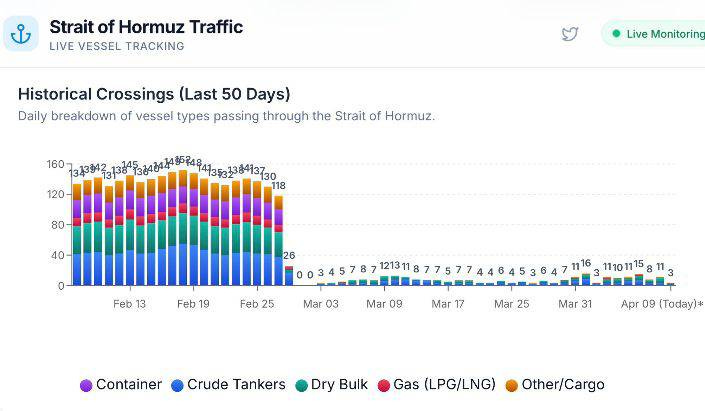
Four days into the ceasefire, traffic is effectively still completely stalled.
And Iran has been clear that it will not reopen the Strait unless its ceasefire terms, including the end of the Israeli bombardment of Lebanon, are met. The US has so far shown little sign that it will rein in its rabid genocidal colony of thieves.
So the Strait will stay closed.
What this means is that right now, we’re eating into the liquid fuels, gasses and petrochemical by-products that exited the Strait and were on their way to global destinations on February 27th.
A tanker moves at about the speed of a push bike. The global economy therefore is operating on a pre-war economy of abundance. The lubricants, both metaphorically and in reality, are still moving through the system, greasing the cogs and pistons.
Because of this, the consequences that were put in motion as a result of the US-Israeli attack on Iran have yet to be realised in meaningful ways for many of us.
And I’m not sure anyone really understands this.
Countries in Asia closer to the Strait have begun to feel the pinch. Because tankers that exited on February 27th off loaded in those countries a couple of weeks ago, so now the glass is emptying for them first.
They’re adapting in a variety of ways. The richer Asian countries, including Japan, South Korea and China, could afford to stockpile and so are more resilient. But all have begun eating into their large stockpiles of oil (around 200 days for Japan and South Korea), and strategic reserves. The more vulnerable counties in the region with limited stockpiles, such as the Philippines, Thailand, Pakistan and Bangladesh are relying on fuel subsidies, price controls, and preparing emergency rationing plans. Some like Bangladesh and Sri Lanka have initiated rolling blackouts and four-day weeks.
The east is a looking glass, portending many of our futures. The fuel shortages eventually will arrive everywhere. This is an inevitability. Physical reality determines and demands it.
As I wrote about before, in the coming weeks and months, the atoms and molecules are simply not going to be where they are wanted and needed in the quantities required.
There will be more in some places, less in others, depending on stockpiles, contracts and access to US, Canadian and Russian energy markets, but the overall global system will not be able to adjust to this supply shock and re-balance smoothly.
I’m re-emphasising the point because, again, it would be very easy, given the ceasefire talks, given Iran hasn’t been bombed for a few days and hasn’t launched in retaliation, to be lulled into a false sense of security/abundance.
We look around, the war seems to be winding down, and things are still ticking along. But it’s like looking out into the stars. We’re looking at the past.
The Italian newspaper Corriere della Sera reported that the last tanker of jet fuel from the Persian Gulf to Europe arrived in Rotterdam yesterday. After that, European supply stops and will only restart once the Strait reopens. Europe might try to buy some from the US and Canada, but both are likely to hold on to their own supply for the most part. Russia may sell a bit, but is in no mood to help Europe out in any significant way. Major European airports keep just a few days of jet fuel in storage tanks on site.
But then that's it.
One in twenty flights were cancelled last week. In the coming weeks, more and more flights will be cancelled. If the Strait stays closed for another few weeks, we are, without exaggeration, looking at the collapse of commercial air travel.
Jet fuel supply will be rationed and prioritised for critical cargo, especially food and medical supplies.
But if the closure really drags on, even that will run out eventually.
And no government in the world appears to be telling their citizens what’s coming. Most people are clueless. No serious measures have yet been announced. Not only because authorities don’t want people to panic, but because the experience of covid has made people fundamentally distrust authorities in a crisis. So governments are being more cautious than ever.
Crisis response has been politicised. It’s a problem.
I suspect there’s also an optimism bias in action, a sense that things are just going to be ok.

That certainly seems to be driving the market response.
And as most of our governments are middle manager technocrats who look to the markets for divine guidance, the lack of market reaction is feeding into the lack of political reaction.
So what can we do as individuals?
Most of us, not a lot. If you drive, fill some jerry cans with fuel at the current price. And although food right now is somewhat less of a problem, throwing a few extra non-perishable jars and tins in the basket isn’t a bad idea. Because even despite record high wheat and rice stockpiles, and fertiliser prices below Ukraine war levels, food prices are rising. Sugar is up 7%, followed by vegetable oil and wheat at more than 4%. Dairy and meat prices are also rising. The longer the Strait stays closed, the more prices will rise.
Beyond a bit of low-level prep, let’s hope for the best.
But if you care about justice, it’s hard to know what “the best” would be.
Iran shouldn’t cave on its demands because the US-Israel started a war that blew up the global economy. They should hold out for the best deal possible, for an end to the impunity of imperial violence, sanctions relief and a new arrangement in the Strait. Some argue that pushing for this outcome could, paradoxically, drive the US back to consequence-free imperial violence. But that will only provoke more Iranian missiles and worsen the global economic situation. And the Americans, for all their murderous stupidity, know this.
US planners also know that for all the talk of American fuel self-sufficiency, this only applies in a narrow way. The US imports significantly from Canada and Mexico, its refineries are integrated into global flows, and domestic oil gets priced against international benchmarks. Shortages anywhere affect prices everywhere, even the US. And the US also still does import more than 10% of its oil from the Persian Gulf.
So a re-escalation against Iran will be bad for everyone, including the Americans. Which is why I don’t think they will return to war.
I could be wrong, obviously.
But a resumption of the war on the same attritional terms as before doesn’t achieve anything for the US and just makes a bad situation worse. Already a massive amount of infrastructure has been damaged. In the final salvo before the ceasefire, Iran hit the East-West pipeline which enables Saudi oil to bypass Hormuz and be piped straight to the Red Sea for export. The attack has taken out about 10% of supply through this route. Iran held off until the last day, a strategic decision designed to signal that they know where the key oil routes are and will keep hitting them if they don’t get a deal on, or close to, their terms.
The only military escalation that could change anything is a full ground invasion to enact regime change, à la Iraq. But this won’t happen. The US does not have the troops, they can’t rouse an Iraq-style 30 country “coalition of the willing”, and Iran is not Iraq, either in terms of geography or the willingness of the average Iranian to let American troops walk into their capital.
A limited island invasion, mooted as likely by some, may succeed militarily, but strategically doesn’t make sense. Taking an island or two by the Hormuz pinch point would, far from force a reopening, turn the Strait into a war zone. And taking Kharg island, the hub of Iranian oil production and export, also makes no sense. What are they going to do with it? They need the tankers to be exporting Iranian oil to avoid a global depression. They’re not going to take Kharg only to let operations keep running as before. And Iran isn’t going to do a Venezuela and sign over their oil rights if Kharg was taken. In the event of a Kharg invasion, it would be back to war and a global depression would loom.
I’ve seen a lot of analysis that says this ceasefire is designed only to buy time for the US-Israel to regroup and either go back to bombing Iran or start some kind of ground invasion. I totally get the scepticism. But when I play any likely sequence of events forward in my head, I only ever reach the conclusion that a resumption would be so bad for the world, and so unlikely to achieve any outcome favourable to the US, that almost everyone is motivated to avoid it happening.
Stopping Israeli mass murder in Lebanon is the hardest point to negotiate. But I’m going to stick my neck out and go against the grain somewhat. I think the ceasefire will hold.
I think Trump, at the behest of his ego, his narcissism, and Israel, has fucked it for empire and helped deliver a true anti-imperial victory. One for the ages. One that could really change everything. And I’m going to do something more comprehensive on that next week.
So, assuming the US doesn’t revisit the plan to plunge the world into a permanent, epoch-defining depression by rage-destroying everything in the country, Iran is firmly in the driving seat.
What comes next, including how long the Strait remains closed, is up to them.
What comes next for us are higher prices and shortages.
(If you appreciate my analysis please consider buying me a coffee or upgrading your subscription. Your financial support is invaluable.)
Thanks Nate!
"And as most of our governments are middle manager technocrats who look to the markets for divine guidance, the lack of market reaction is feeding into the lack of political reaction."
The market is like a casino: the house always wins. The "house" in this case is uniformly Zionist. Only a small percentage of people own most of the stocks. Finance is dominated by an even smaller group. This small group controls the markers in the US and it is nearly all Zionist. These Israeli firsters can and do act collectively when something sacred to them all is at stake: Israel and it's insane push for lebensraum. They have been using every trick in the book over the last month to prevent any natural market reaction to the closed strait. They collectively struggle to ensure Trump can continue his assault on the innocent people of Iran as long as possible. Yes they are all greedy capitalist pigs, but they are also members of a cult. Eventually, as you said, gravity will have to kick in and it will be every Capitalist pig for himself, once again. Once that happens, we can celebrate Iran's victory for humanity.
In terms of the western wage slaves that will wrongly suffer due to the crimes of their Zio billionaire overlords, I can only speak for myself. Im happy to endure it so long as it reduces the ability of the Zio Imperialist ruling class of the West to continue killing innocent wage slaves in Iran, Palestine and across the ME.
Death to Zio Imperialism!
America can’t and won’t accept Iran is in the box seat. Which won’t change until it hurts the Epstein Class hip pockets . I for one will deal with it till Iran wins .