
Hug Your Loved Ones

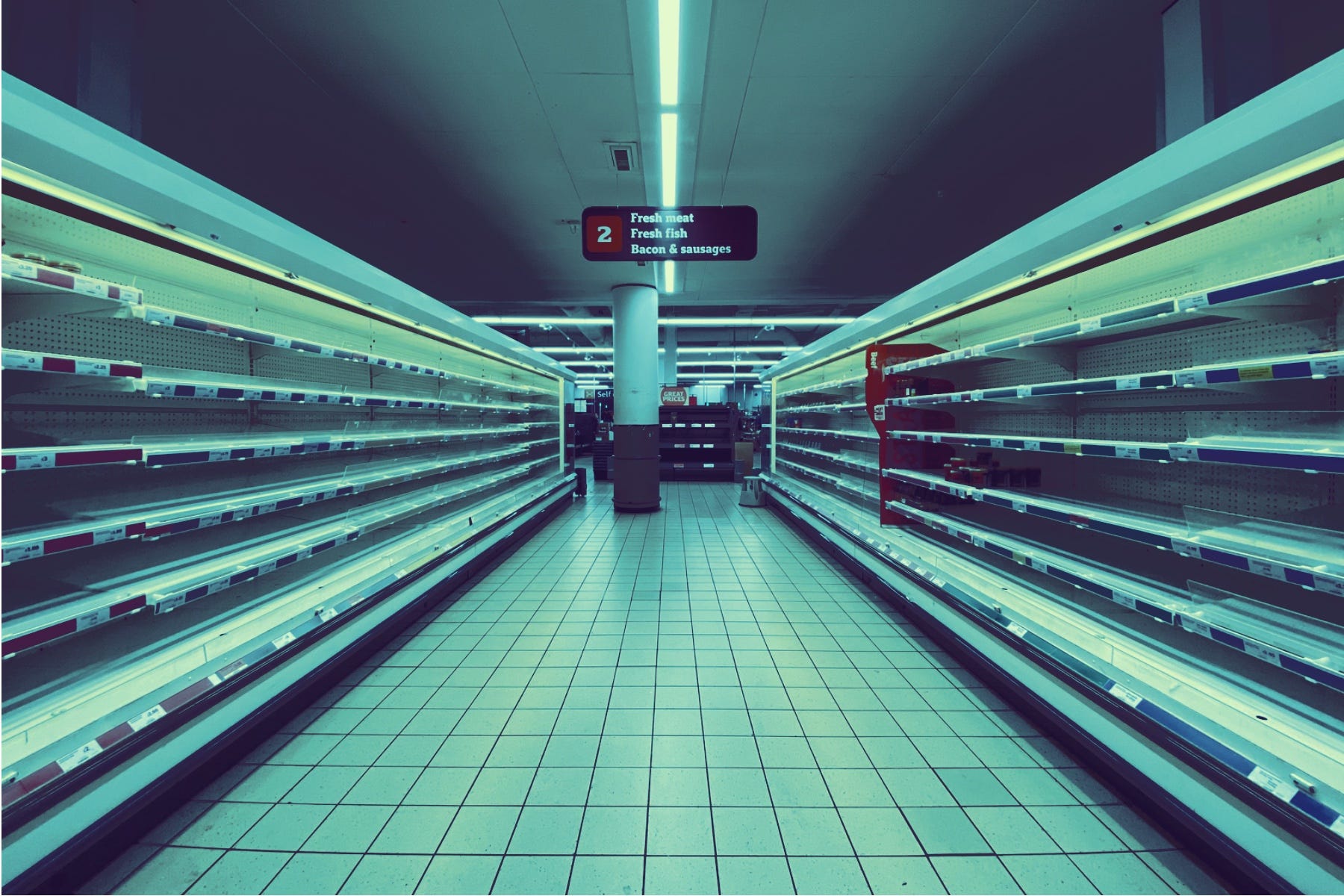
I posted the below tweet yesterday.
It went viral.
Some people got annoyed.
Some said it was tedious, panicky, doomy.

The author and critic Yasha Levine said humanity has survived worse.
I received messages telling me to fuck off, that I was loser.
All for making what I thought was a pretty accurate, uncontroversial post.
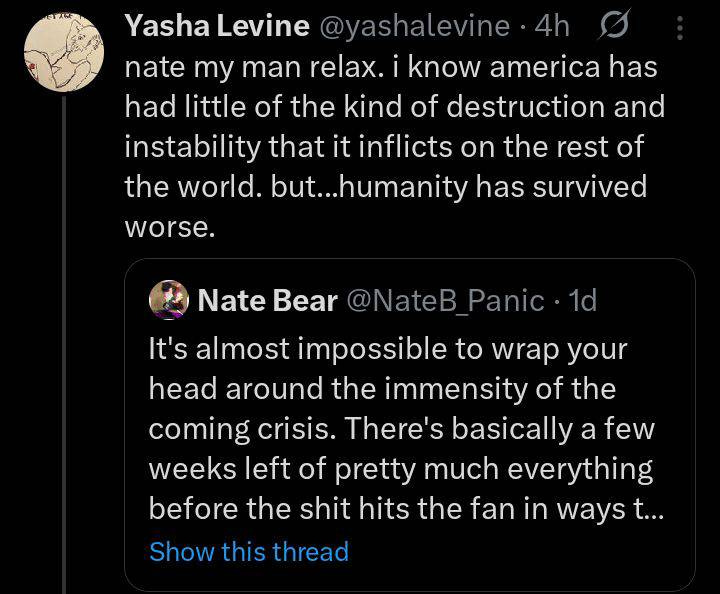
Why did it provoke such a response?
Because people, especially Americans, are scared.
Scared that I’m right. Scared it’s true. Scared, basically, that the treats are going to be taken away.
And when they say humanity has survived worse, of course they’re right on that. But they’re coping. Humanity has literally survived everything. So downplaying the severity of this moment by saying it isn’t going to be an extinction level event is not the reassurance the scolds might hope.
The title is a somewhat tongue-in-cheek response to the critics. Of course humanity will survive this. But what will things look like through the bottleneck? What will come out on the other side?
I thought I’d put some flesh on the bones, sketch out what we’re looking at here.
This is the biggest energy shock since world war two, exceeding the oil crises of the 1970s and the Russia-Ukraine war, which previously were the biggest energy shocks in modern history.
The 1970s oil crisis struck 5 million barrels of oil per day off global markets. The war on Iran has caused an 11 million barrels of oil a day shortfall. The Russia-Ukraine war at its peak removed about 75 billion cubic metres of gas from the world. The war on Iran has caused a 140 billion cubic metres loss of gas.
Oil and gas are pretty much everything. Oil isn’t just fuel to get everything, including human bodies, from one place to another, it is also plastics, paints, solvents, cosmetics, engine lubricants.
Gas isn’t just used for cooking. Around 23% of the world’s electricity is generated by gas.
Gas-fired power plants also produce steel, cement and glass. Most importantly, gas is central to food production, serving as the primary raw material and energy source for nitrogen fertilisers.
Food.
More than 30% of the world’s fertiliser (urea, phosphate and ammonia) is produced in Gulf countries before moving through the Strait of Hormuz.
We are right at the start of the planting season, when fertiliser availability is most critical, and there is a global fertiliser shortage.
The US has already reported a 25% supply shortfall of urea.
Reduced yields and higher prices are an inevitability. How reduced and how high the prices go depends on how long the US-Israel keep their illegal attacks up.
Plastics.
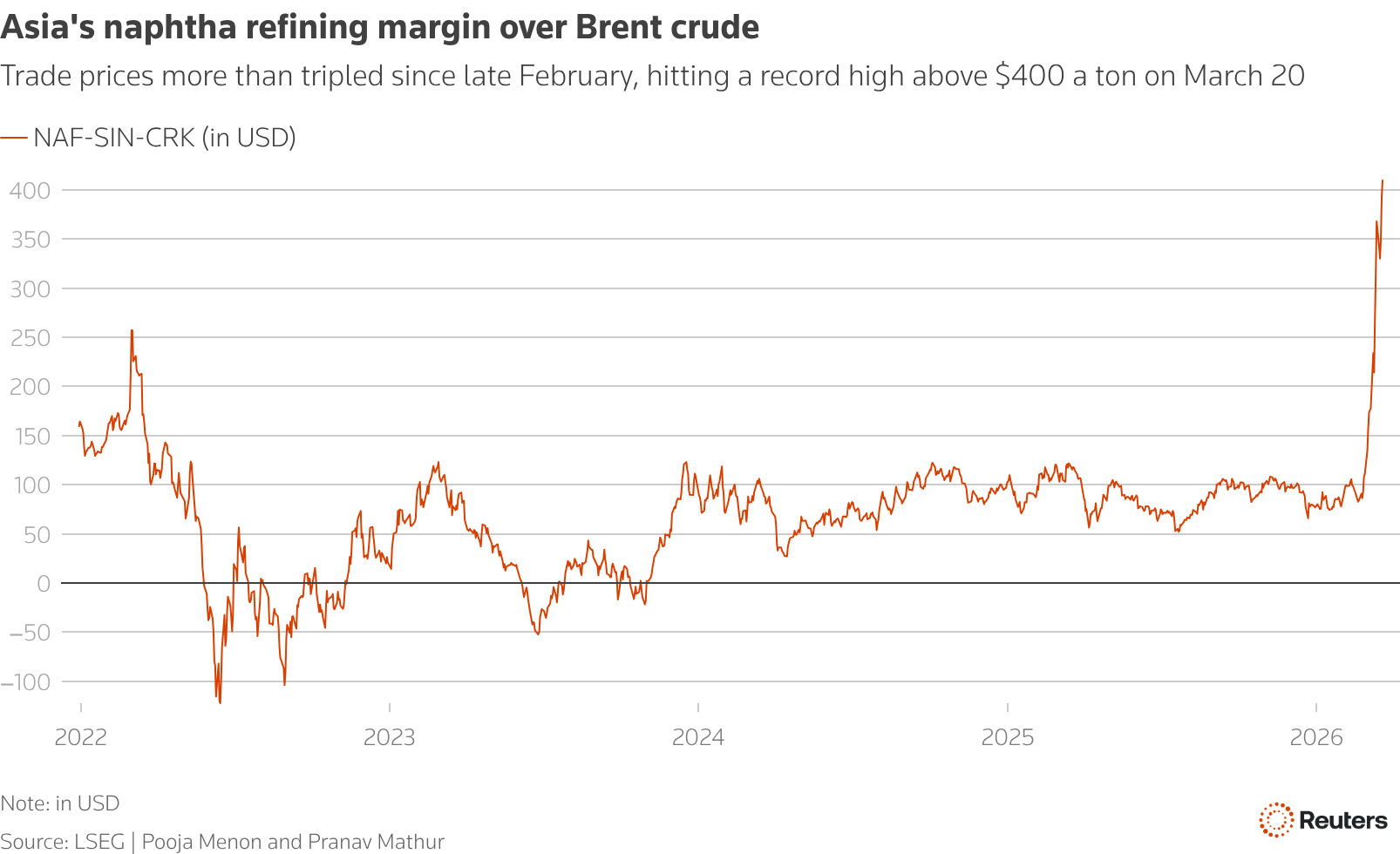
The Middle East accounts for over 40% of polyethylene exports. Polyethylene, the most commonly used plastic, is made using naptha, a petroleum derivative obtained during the distillation of crude oil. In a month, Asia’s naptha refining margin (the profit difference between the selling price of naphtha and the cost of the Brent crude oil used to produce it) has gone from around $100 dollars to $400 dollars.
A quote from a plastics analyst in the linked Reuters story stands out:
"Anyone who imports from the Middle East, which is pretty much everyone in the rest of the world (outside the US to a certain extent), has lost a large supplier and is having to scramble to find replacement resin at extraordinarily higher prices."
You might be thinking less plastic is a good thing, and if this was a managed reduction with alternatives in place it would be, but plastic is irreplaceable for many things including transporting and storing water, especially critical in the global south. Plastic is also essential to the medical industry and for transporting and storing drugs, and plastic parts are integral to complex medical devices. Basic medical equipment like surgical gloves also rely on plastic.
And plastic shortages are already driving higher prices for bottled water and medical equipment.
Plastics are also essential to almost every single consumer item in existence. So less plastic in the market means fewer jobs because less consumer stuff is able to be produced, which means business failures.
And this less input > less output > fewer jobs > business failures formula as a result of the shortages can be applied pretty much across the economic board.
Aluminium.
A critical mineral used in buildings, windows, doors, cars, planes, trains, food and drink packaging.
If you want to hit the global economy where it hurts, hit aluminium. And this weekend, in response to critical industrial sites being bombed, that is exactly what Iran did. It hit the two biggest aluminium smelters in the Middle East, both major suppliers to the United States. The world uses 70 million tonnes of aluminium a year. The attacks have taken 3 million of that offline. And note, this is not a question of halted transportation. These smelters are out of action. And the US imports more than 20% of its aluminium from these two smelters alone.
Helium.
More than just party balloons, helium is critical to making MRI machines, microchips and semiconductors, and is central to the AI boom. Qatar is home to one of only two plants that produce semiconductor-grade helium, which is ionized and used to etch silicon wafers.
When Israel struck Iran’s gas fields, Iran struck back at Qatar’s gas production plants. Now one-third of the world's helium has been removed from the global market. This reduction has yet to ripple through to production schedules because enough surplus helium was stored, but the forecast is for a 15% shortage in the coming months.
Again though, this isn’t a transit issue that, in theory, can resolve quickly. The physical infrastructure underlying production has been damaged.
Movement.
Oil is movement. Cars, trucks, planes and trains.
And movement, basically, is the local and global economy.
The price at the pump is spiking around the world, and countries have begun introducing control measures, including rationing.
Because Asia is most reliant on Middle East oil and gas, the shortages and rationing have begun there first, before rippling westwards.
The Philippines has introduced a four-day week, as has Pakistan. Bangladesh has imposed nationwide fuel rationing and rolling blackouts, as has Sri Lanka, and Thailand has ordered all government employees to work from home. In Africa, Egypt is closing malls and office early, South Sudan has introduced rationing and Kenya is prioritising who gets fuel. Slovenia last week became the first EU country to introduce fuel rationing.
You can also blame imperialism and Zionism for your aborted, or eye-wateringly expensive, summer holiday.
This Monday, owing to jet fuel shortages, one in twenty flights globally were cancelled.
These are the headline shortages, measures and impacts, but there are so many second, third and forth order effects, from geopolitical reordering to massive nuclear proliferation, that it’s mindboggling.
And the war isn’t over. The US-Israel are still bombing, and Iran is still responding. Ground troops are still possible, as is a final massive bombing salvo on the way out, as Trump hinted at the other day. Such a salvo would be, quite rightly, responded to in kind by Iran.
The costs of imperialism and Zionism are coming home.
All of us who said empowering an apartheid state to do genocide would embolden it to commit further crimes that will eventually drag the whole world down were right. But we were called antisemites and criminalised for this foresight.
The shit is hitting the fan and we’re about to see what happens under conditions of stress that the modern global economy has never experienced.
And I have to tell you, I’m not unhappy about this. That’s not the place this piece is coming from.
On the contrary.
I’m glad Iran struck back and gave the world a lesson in what happens when you let US imperialism and Jewish state supremacy run wild. I’m glad that there are real, material, substantive costs being inflicted as a result of US-Zionist impunity. I’m glad the US and Israel are getting bloodied.
But this all could have been avoided.
Europe could have confronted Israel and US over the Gaza genocide. They could have stood up to them when they knew they were about to attack Iran. They could have condemned their actions on the first day of war and denied them the use of bases and airspace. Iranian leaders, after all, had said for months exactly how they’d respond if attacked.
But instead through a combination of cowardice, racism, imperialism and rank immorality, western leaders let the US-Israel sink the global economy and immiserate billions while watching, or actively aiding, the US-Israel in destroying another country. It’s not just Europe though. Asian leaders have been largely silent or deferential, as we saw with Japan’s Sanae Takaichi and her obsequious behaviour in front of Trump earlier this month.
There is a lot of blame to go around, and in time, perhaps, this war will shake the global order in positive ways. Perhaps Europe, the Gulf countries and US-aligned Asian countries will wake up to the fact that the Americans do not give a fuck about them. Maybe they’ll figure out that the only country US leaders care about outside their own, is Israel.
Maybe this will be the final straw that solidifies this as the Chinese century.
But I wouldn’t pretend that what emerges on the other side of this crisis is automatically going to be good. I wouldn’t pretend, despite what looks like being a strategic defeat, this is the death-knell for US hegemony.
You can tell an extremely plausible story about how the war on Iran solidifies, not undermines, long-term US hegemony.
You can tell an extremely plausible story of more imperialist death and destruction as a failing empire lashes and crashes out.
And there’s time to tell those stories and sketch out those futures.
But first, let’s all try and get to the other side.
(If you appreciate my work please consider buying me a coffee, or upgrading your subscription. You can also just subscribe for free).
Thank you, Nate, for doing so much research so that we can better understand the ramifications of what the war lords are doing.
The whole notion of "humanity has survived worse" is so weak.It is a ruse to deny and distract from the horrors that are happening now.
Humanity has never before been able to cause this much far-reaching damage.
Heaven help us.
Yasha Levine. For all his left posturing, he's a crypto Zio. I wouldn't listen to a word he says.