
The Ukraine Delusion

I’ve held back on writing about the Russia-Ukraine war, and this article probably won’t win me many fans. But for better or worse, I always try to tell it how I, at least, see it. And I’m tired. Tired of the liberal delusion, the hypocrisy, the childish analysis, and outright bloodthirstiness over Ukraine.
I’m tired of the pretence that a proxy war which has now lasted longer that the first world war is a righteous battle against evil for the soul of the world.
I’m tired of the fact that wanting an end to a war which has killed hundreds of thousands of young men, and thousands of civilians, is seen by some as an outrageous, morally deplorable position.
I’m tired of the fact that rational analysis and context is so often labelled as pro-Putin apologia, and how it is almost impossible to get good information on the war that isn’t polluted by an anti-Russia agenda. And even good information and analysis which recognises that Russia isn’t losing, that Ukraine is suffering, still too often suggests that the west must wage this war for many more years. This otherwise rational analysis, while detailing all the ways in which Ukraine is definitely not winning the war, nevertheless concludes that it must be fought for many more years to avoid “a bad peace.”
Time and again we see the same conclusion. That to give Russia what it wants, namely Crimea, the four annexed oblasts and a neutral Ukraine, would be a “bad peace” that rewards aggression. But few politicians or journalists when selling this story ever spell out explicitly what a “good peace” is and what it would require. But we don’t have to guess. Zelensky has on many occasions. And he has maintained the only way the war can end is if Russia returns to Ukraine not just the four oblasts annexed in 2022, but also Crimea, and he also wants security guarantees which would amount to the effective integration of Ukraine into NATO.
This is a delusional position that guarantees never peace and a forever war. And forever war isn’t an abstract. It means forever death. Forever destruction. It means European societies becoming securitised and militarised, with the Russian foe a ready-made excuse for a Palantir-powered surveillance state. And this position rests atop a childish assertion repeated ad nauseum that grants the war its legitimacy: that Russia’s invasion of Ukraine was “unprovoked.”
Nothing is ever unprovoked. You can agree or disagree with whether the provocation warranted the reaction. But unprovoked is not an analysis, it is an emotional appeal, and in the case of Russia-Ukraine, it is propaganda designed to obscure the long history which led to Russia’s invasion.
It is, in many ways, not dissimilar to the propaganda that October 7th was an unprovoked attack on Israel. Or that Pearl Harbour was an unprovoked attack on the United States.
Narratives which strip out cause and effect and proclaim that a bad thing just happened without any preceding events, that good people were then drawn reluctantly into war to defend themselves against bad people, is the oldest trick in the war propaganda book designed to shut down critical intellectual inquiry.
So, briefly (for more detail read this by John Mearsheimer), the events preceding Russia’s invasion of Ukraine include a 1990 promise made by the US Secretary of State James Baker that if post-Soviet Russia allowed a unified Germany to remained in NATO, "NATO would not shift one inch eastward.” It was a promise made with an understanding that Russia was a legitimate country with legitimate security interests. That promise of course was repeatedly broken until NATO stretched to Russia’s borders. The preceding events also include the NATO-backed remilitarisation of Ukraine following the ousting of Victor Yanukovych in 2014, the Russian annexation of Crimea in response and Ukraine’s bombing of the Donbass which killed hundreds of Russian-speaking Ukrainians. It includes an acute understanding among the Russian leadership that Napoleonic France, imperial Germany, and Nazi Germany all crossed Ukraine to invade Russia itself.
You don’t have to think that Russia was right to invade Ukraine to try and understand why it invaded Ukraine, a consideration we are never prompted to investigate in a discourse dominated by normative moral judgements viewed exclusively through the lens of western imperialism. The shape of post-2014 Ukraine made Russia fearful that the country could once again be the launchpad for an invasion. And it wasn’t as if Putin hid this fact. He repeatedly warned, into late 2021 and early 2022, that the further militarisation of Ukraine was a red line and if Ukraine and the west refused diplomacy, Russia would act. He hadn’t been that bothered about Ukraine before 2014, there was no war talk, because it wasn’t the threat then that he perceived it became.
Again, this is not a defence of Putin, it is a question of cause and effect, and of the western arrogance and hubris that believes only its red lines on geostrategic issues are valid. Would the US have allowed a military alliance led by China to be built up through South America, reaching Mexico without a response? Would western media have dismissed American concerns about Chinese militarism as paranoid nonsense if Chinese military bases were dotted throughout South America? Of course not! The media would have demanded war and sold us war. But when the roles are reversed, American militarism becomes mere Russian paranoia.
And now the war that NATO expansionism threatened is not just here but is in danger of become a permanent fixture of our lives, with European economies embracing the bloodshed and building war economies. And to build these war economies, the liberal class is demanding more cuts to a welfare state already disseminated, in many places, by two decades of austerity. This week the Financial Times ran this article, demonstrating the brazenness with which anti-working class, hyper-capitalist, hyper-imperialist prescriptions are now presented as sensible opinion.
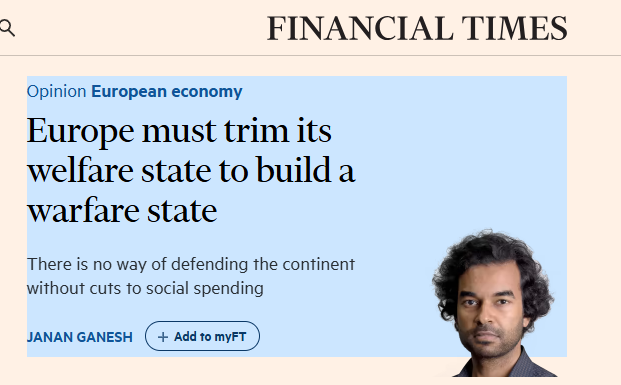
A “warfare state” all to fight a mythical Russia that, as Mearsheimer laid out in this video, didn’t invade Ukraine with anything like a force sufficient to conquer the country, but as a final gambit to force Ukraine to the negotiating table. Of course it failed. The liberal media and political class, however, continue to insist that Russia’s goal is full conquest, with more to follow, in order to legitimise the creation of war economies. That the liberal class would rather build a warfare state that decimates the welfare state to confront Russia, rather than seek diplomacy and partnership with a country which is home to huge volumes of minerals needed to build, for example, a cleaner energy system, is a demonstration of utter failure.
And who would these “warfare state” economies be powered by? In part, Israel, which has agreed a $4 billion deal with Greece to supply an air defence system, supplied a similar system to Germany for the same price last year, and handed over a half billion dollar missile system to Slovakia.
Israel is a part of the Ukraine-Russia war story in other very important ways, some of which now look decidedly self-defeating for Ukraine and Zelensky.
When the Iran war started, Zelensky enthusiastically embraced it and regurgitated all the classics, saying that the US-Israeli assault was a good thing because it would “rid the Iranian people of a terrorist regime.” In March, with the war on Iran raging, he urged Netanyahu to work with him, saying “he has what I need and I have what he needs.” But now Ukraine is out of interceptor missiles because they’ve all been used in the war on Iran, with Kiev defenceless against Russian missile attacks. Yesterday, every missile launched at Kiev hit its target, with zero interceptors launched. And now, after embracing the war on Iran, Zelensky is complaining about the lack of interceptors, a direct consequence of the war he supported. He hitched himself to empire, yet because of the over-stretching imperial adventurism he himself relies on, that empire has found itself unable to defend his country. It reveals a man who has no plan, beyond hoping that the weapons keep flowing.
Liberals appear reluctant to make the connection between the two imperial wars, preferring the dissonance that comes with an empire state of mind.
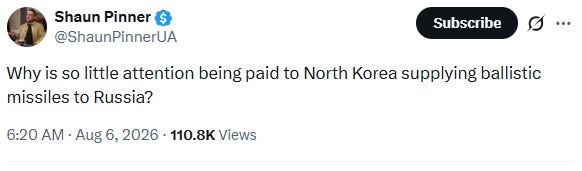
This dissonance has also been on display elsewhere, with pro-Ukraine war influencers demanding the west sends more weapons to Ukraine and incredulous at North Korea sending weapons to Russia, seemingly unable to follow their own logic on third-party countries sending weapons to principal conflict belligerents. Empire brains blinded to their own raging hypocrisy.
But as I’m writing, I can hear a criticism, and can even form one against myself. Why, Nate, when you are so morally strident on Israel and Palestine, are you decrying “normative moral judgements” on Ukraine and Russia?
Because the two situations could not be more different.
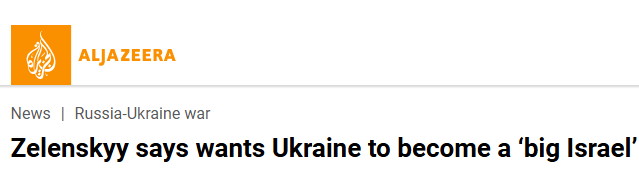
Ukraine is a state with a standing army supported by empire fighting another state with a standing army. Palestine has been denied statehood despite the 1947 UN two-state partition agreement (putting aside whatever one thinks about the legitimacy of that agreement), has no standing army to defend itself and Palestinians are fighting a colonial occupation armed by empire. If anything, Ukraine is far more similar to Israel than it is to Palestine. Indeed, in 2024 Zelensky proclaimed Israel as the ideal model for Ukraine, saying he wanted Ukraine to be a “big Israel.”
Both Ukraine and Israel are proxies at the tip of the imperial spear, one in Europe and one in the Middle East. You don’t have to be the invader to be a tool of imperialism. Sometimes being the invaded is more useful as it imparts a moral surety that helps shield your imperial role from critical analysis. I would argue this is exactly what has happened in the case of Ukraine.
None of this is to say I don’t have sympathy with ordinary Ukrainians. I do. I think they’ve been sold down the river, by both Europe and their own leaders, and have been coerced into fighting a war a majority now want to end with negotiations. The average Ukrainian is quite different to the average genocide-supporting Israeli who upholds apartheid.
Yet despite the wishes of a majority of Ukrainians, Europe and Zelensky refuse diplomacy and continue to fight, incurring enormous costs on Ukraine and ordinary Ukrainians. Of course, enormous costs are being inflicted on Russia too, but these costs have not been, and will not be sufficient for a “good peace.” And any costs that would really bite risk an uncontrolled, catastrophic escalation.
The final irony is that despite the war being marketed to westerners as totalitarianism versus democracy, Ukrainians can’t even elect a leader who would enact their wish to see a negotiated end to the war since Zelensky, whose term officially expired in 2024, introduced martial law and cancelled elections.
So, as I said, for better or worse, this is my perspective on Russia-Ukraine.
A war which advances only imperialist interests, interests which run counter to European security and prosperity. A war which threatens, at worst, to go nuclear. A war which wasn’t unprovoked. A war which, with their minds empty and hearts lacking true solidarity, consciousness or justice, has become a necessary intellectual organising principle for the liberal media and political class.
I’ve probably not made many fans, but I’d be delighted if I have.
(If you appreciate my writing please consider supporting me by making a donation here. You can also upgrade your subscription).
Exactly how I see it too. I've had a serious argument with someone in our Palestine support group over this. He accused me, with disgust, of being a "tankie" for saying that Putin had a point. People do not connect these wars. But, of course, they ARE linked particularly through countries such as Germany, the US and Britain.
Delusional Americans will hate you for this because it is the truth they don't want to face.