

A friend asked me the other day if I’ve considered writing a positive article as a one-off for Christmas.
My friend was making a joke. Kind of, sort of. And I understood where he was coming from.
I said no.
I’m not a therapist. I’m not here to make anyone feel good about the direction of civilisation. Because the direction of civilisation isn’t good.
And that being the case, what’s an honest man to do?
If you’re reading this, you may have been confronted with a similar complaint.
But I’m not going to paint lipstick on a pig.
Not because I’m a masochist who wants to make people sad. I’m not going to do it for radical, material reasons. For, you might say, positive reasons.
Yellow ribbon stories
At university, the professor who introduced me to anti-imperial perspectives, who had me reading Manufacturing Consent as a matter of urgency, explained that we should always beware of what he described as yellow ribbon stories. He said these were the good news stories found at the end of mainstream news broadcasts, usually focused on community initiatives. These initiatives, he said, were often run by or designed to help military veterans, or were in partnership with some corporation or another. My professor explained that these stories were positioned intentionally at the end of the news broadcast, purposefully designed to soften the preceding news about war, killing and injustice, and to buttress imperial capitalist narratives. Watch out for them, he said. I was being taught this class during the second Iraq war, so the media environment was replete with opportunities to spot these yellow ribbon stories. And as soon as I started to look, I couldn’t stop seeing.
This was a gateway insight into mainstream propaganda and it’s shaped my thinking and my writing ever since. So no, you’ll never find a yellow ribbon story here, not even at Christmas.
Because the system relies on yellow ribbon stories.
Yellow ribbon stories fall into the broad category of positivity and progress. Imperial capitalist hype, basically. And it is the reproduction of these stories that helps uphold the status quo. Tales of progress stifle agitation and demands for change. If the world is getting better, why protest, why complain? Progress narratives reinforce a central theme of neoliberal political-economic management: calm down radical, the adults are in charge.
On the flip side of the progress peddlers, you have the so-called doomers, a pejorative label designed to discredit conveyers of bad news as cynics and curmudgeons. Doomers are the unserious people not sufficiently invested in the marvels of our neoliberal world.
Who knows where the label originated, but I wouldn’t be surprised if it was seeded by a progress liberal. You know the type. Bill Gates, Hans Rosling, Steven Pinker. Academics and public figures who get up on that TED Talk stage and spam us with bar graph after pie chart of the world getting better. Through their books and the lecture circuits, progress peddlers have made good names and careers for themselves, aided by the neoliberal elite who invite them to speak and write for the status quo institutions they manage. They have many handmaidens in the media willing to platform their stories of perpetual progress. And the best thing about progress peddlers is they extol the wonderful features of neoliberal capitalism with that most-prized of late-capitalist assets: data.
The world, they insist, is getting better and better. You need do nothing. Just sit back and let neoliberal market forces do the work of progress. There is no need to dirty your middle class hands, because you, global north citizen, have a pass. You might feel sad about the brown and black faces streamed with tears of war-time anguish or gaunt from starvation, and it is indeed sad. But the best thing you can do for the global south, for the hungry and the genocided, is to keep buying, spending, and participating in imperial capitalism.
Buy, buy, buy. Sell, sell, sell.
The market is the one true and abiding force for justice.
The best thing you can do for the downtrodden is let history unfold its benevolent wings.
I can hear the cries now. But Nate, your sarcastic affect doesn’t change reality! Things are getting better!
Ok. Because I am, like I said, an honest man, I don’t want to cynically write this narrative off without examination.
Dispossession and the newly urbanised
The primary claim made by progress liberals is that global poverty has plummeted extraordinarily over the last two-hundred years. Specifically, Bill Gates presented to the Davos elite a research paper that claimed the proportion of people living in poverty has declined from 94% in 1820 to 10% today.
This claim has been taken apart by academics in recent years, most notably by Jason Hickel. Hickel’s first critique is that the progress peddlers base their conclusions on how much cash money every person on Earth now has, relative to 1820. But in 1820, vast swathes of the planet didn’t rely on money! Hickel says, therefore, that what is presented as poverty reduction is in fact the forcing of people into the capitalist labour system through the dispossession of lands. An indigenous person who had access to shelter, warmth, water, seeds and land to grow food didn’t understand the concept of poverty. When these means of subsistence were stolen from them (as they were stolen from hundreds of millions through colonisation abroad and the theft of land through enclosure at home) people were forced into poverty. By capitalism. By the very system liberals laud. The basic means of survival were no longer free. The trade and barter system people shared with neighbouring villages or tribes was destroyed. The transformation of land from a free-to-use public asset into a vehicle for private profit robbed people of autonomy. They now had to sell their labour to buy food and shelter. A shelter built on previously public land. They were made poor. Some may have been made less poor since being forced into the system that created modern poverty, sure. But progress peddlers ignore poverty’s origin story.
And they also ignore something more fundamental: the value of money. Hickel explains that all the fantastical claims about global poverty reduction rely on a poverty line of $1.90 (£1.44) per day. If you earn more than this, you are no longer poor. This, of course, is an obscenely low number which massively inflates claims of a neoliberal miracle. Taking a more reasonable, but still conservative poverty line, shows a very different picture. When poverty is re-categorised as anyone earning less than $7.40 per day, the number of people in poverty since 1981, when proper record-keeping began, has actually grown, reaching 4.2 billion people today. And many economists argue that the true measure of poverty should be set higher than that, at 10 or 15 dollars a day.
Finally, Hickel says the majority of poverty reduction has happened in China. But the progress peddlers rarely give credit to China. Because China isn’t the ‘correct’ model. China, a quasi-capitalist economy directed largely by the state, is not a neoliberal capitalist market economy. To give credit to China would ruin their narratives.
In the real world, poverty outside of China has barely budged and in many places has got worse.
Ok Nate, maybe the picture isn’t as clear as I thought. But what about life expectancy? It has skyrocketed!
Fine.
Hard to argue with this one.
But not hard to inject context.
Life expectancy has indeed increased for much of the world in recent decades, through the second half of the twentieth century particularly. But, again, we have the problem of baselines.
In the first half of the 19th century, average life expectancy for labourers in Liverpool, for example, was just fifteen years old. Tradesman in the city hardly had it any better.

The immiseration wrought by forcing people out of the countryside and into cities during the industrial revolution was stunning. Of course the average life expectancy of a worker in Liverpool or anywhere in the UK looks like a miracle next to the numbers that the industrial revolution was putting up through the 19th and into the 20th century.
The progress peddlers never mention that their baselines start at what might be historic low points. This is not to say that modern medicine hasn’t helped deliver longer life expectancy. Research shows that access to modern medicine, especially antibiotics and early life vaccines, has extended life spans. Sanitary healthcare facilities and plumbing systems have also helped greatly. But these things are for the most part basic science and engineering, developed equally by socialist states in the 20th century. These gains are independent of neoliberal capitalism.
Modern 21st century life, on the whole, doesn’t equal a healthy life.
Humans living in industrial capitalist societies are plagued by heart disease, autoimmune diseases and dementia. Indigenous tribes, to this day, do not suffer the same ailments. The Tsimane, a tribe in the Bolivian Amazon, have the lowest levels of coronary artery disease of any population ever recorded. The Tsimane also experience a 70% slower decrease in brain volume over the course of their lives than adults in modern, progress-infused Western populations.
If we’re on the topic of indigenous peoples and health, the progress peddlers will never remind you that colonisation killed 90% of everyone alive in the Americas, primarily through the spread of infectious disease. Western colonisers, the expansionist, growth-minded spiritual heirs to the progress peddlers, killed so many people they changed the climate of the Earth. With villages and towns wiped out, vast swathes of depopulated land were reclaimed by nature, and the newly thriving vegetation pulled so much carbon dioxide out of the air it rapidly and dangerously cooled the planet.
Staying on the topic of infectious disease, it was an infectious disease that caused the biggest drop in global life expectancy in modern history. A virus, SarsCov2, whose spread was aided by industrial-scale trade and travel, one of the hallmarks of modern concepts of progress. A virus which may, if it did indeed leak from a laboratory, have been the result of attempts at progress itself.
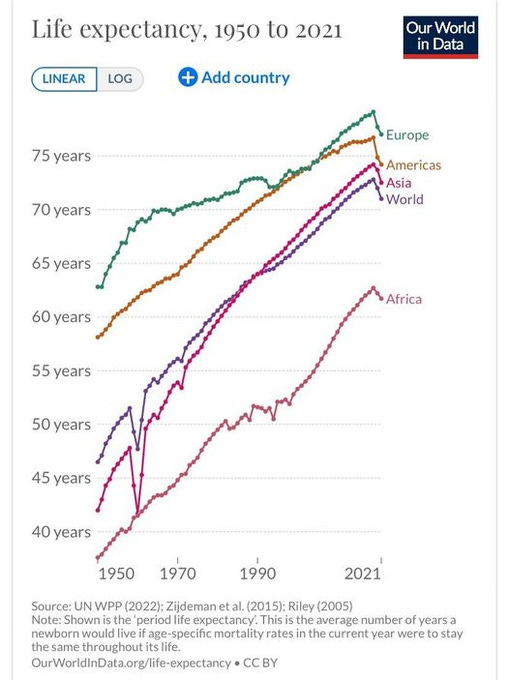
Even now, five years later, public health has not recovered from covid. Most people won’t know this, because it doesn’t fit the progress narrative. In the UK and US, deaths per 1,000 people remain elevated beyond pre-covid levels, with deaths per capita sticking somewhere around 2005 levels. With covid now a fixture of our societies, non-seasonal and capable of serious harm, we’re unlikely to ever get back to the low points. Owing to covid, drugs and environmental factors, 25-44 year-olds now have a 70% higher chance of dying than in 2010.
Progress, they say.
Back to the Tsimane. They have healthy hearts and brains, but because they lack access to antibiotics and antiparasitic medications, they do still die, on average, in their 50s.
Ah ha! Gotcha Nate!
Afraid not. Because what progress peddlers will never tell you is that the places where people are healthiest and live longest are the places where neoliberal capitalism is less well dug-in. Places that are more isolated and less exposed to trade. Places where official unemployment is extremely high. Places where the productivity beloved of liberals is low. Where local economies, not financialised ones, still thrive. Where food is still fresh. Where traditions are ancient. Where the pace of life is slow.
I’ve written, about these longevity hotspots, dubbed ‘blue zones,’ before. Icaria, a small Greek island. Ogliastra, on the Italian island of Sardinia. The Japanese island of Okinawa. The Nicoya Peninsula in eastern Costa Rica.
You’ll never hear Bill Gates or Steven Pinker argue for the localism, deurbanisaton and degrowth that might deliver a world of Ikarias and Okinawas. Under global industrial capitalism, a blue zone lifestyle is unattainable for most and would simply not be tolerated on a large scale by the neoliberal elite.
With all this talk of long life expectancy, I’m in danger of straying into positive territory. So let’s look at some other metrics delivered to us by imperial capitalism.
Using the Gini coefficient, the gold-standard measure of income distribution, modern America is a more unequal place than slave-owning Rome.
The number of billionaires on the planet has nearly tripled in 17 years, from 1,125 in 2008 to more than 3,000 in 2025. Their combined wealth is more than the GDP of every country in the world bar the US and China. This is an unprecedented level of oligarchic wealth concentration, and this wealth confers unprecedented power, which, as far as the direction of a civilisation is concerned, is the only thing that matters in the end.
In terms of pure financial wealth, this is the richest civilisation that has ever existed in the history of the planet, yet 4.6 million people still lack access to basic medical services. More growth isn’t going to solve that problem. Another few trillion isn’t going to extend healthcare to the more than half the planet that doesn’t have it. This injustice, like so many in our world, isn’t about the size of the pie, but about how it’s shared.
Eight men own the same wealth as half the people on the planet for god’s sake.
It’s absurd, pure bird-brained thinking to claim more growth is the solution.
The problem is power, wealth and its distribution.
The solution is taking power and wealth off the elite and redistributing it.
But if you think the world is getting better under a system that produces such inequality, you’re hardly likely to come to this conclusion. Which gets to the nub of why a story of progress has been so elevated by the neoliberal managers of the world.
In the UK real wages stop growing in 2008. Since then inflation has largely outpaced wage growth. So getting on for 20 years, the average monthly wage has bought the average Brit less and less.
What happened in 2008? That’s right. The collapse of the financialised neoliberal system that was delivering all this progress.
In the UK, those on the lowest incomes now spend an astonishing 63% of their incomes on rent, a near 10% increase in a few years.
In the US, the picture is marginally better. Wages have grown nearly 80% since the financial crisis but real wage growth is only around 12%. People are also spending more on essentials such as housing and healthcare than ever before.
Zooming out, the ecological systems of Earth are being destroyed. There’s a terrifying series of graphs developed by environmental scientists showing the damage industrial capitalism is wreaking on the planet. From the extraordinary increase in greenhouse gases, to booming plastic production, to coastal nitrogen pollution, to deforestation and ocean acidification. The last fifty years of supercharged global capitalism have pummelled the Earth more than the last 5,000 ever did.
Progress, they say.
Progress liberals of course, have nothing to say about genocide. Nothing to say about the industrialised slaughter of hundreds of thousands of human beings by the western system of war-faring imperialism they try to convince us is life-affirming and life-saving. A recent estimate by two Australian academics puts the number of murdered in Gaza at 680,000. To this mass killing there is only silence from modernity’s evangelists.
(As an aside, it comes as no surprise that two key proponents of the progress narrative, Bill Gates and Steven Pinker, were close friends with Jeffrey Epstein, a hardcore Zionist, race science advocate and likely Israeli intelligence asset).
Whether in Gaza, Iraq or Venezuela, mass death at the hands of the imperial war machine has never energised a liberal or given them cause to re-consider their concepts of progress.
Their stories of progress are not my progress.
Their positive news is not my positive news.
You might be familiar with the website Positive News which positions itself as a corrective to negativity.
I took a look the other day. One of the positive events of the last week, we’re told, is that an advocacy group had worked with Microsoft to ensure that non-western names weren’t mislabelled in Word as spelling errors by the appearance of the squiggly red line. This apparently, was ‘a sign that some identities were invalid’ and the change to the Word software means that ‘positive change is possible when we work together.’ Look, I’m as woke as they come. Radical woke. Resistance everywhere. End all injustice. But I’m sorry. This is laughable. The yellowest of yellow ribbon stories. The precise type of performative nonsense that gives woke a bad name. Woke for representation liberals who aren’t interested in real material change.
Browsing further, I took a look at the top 25 positive news stories of 2025. I would skewer all of them in detail if this wasn’t already a long post. But for example, at 19 was the ‘Gaza ceasefire and hostage deal.’
Honestly.
My stories of hope and positivity will never be these stories.
Hope and positivity comes from resistance. From resistance to corporations like Microsoft. From resistance to fake ceasefire deals that enable genocide under cover, from resistance to the imperialist narratives that promote such lies.
Hope and positivity comes from dismantling the neoliberal story of progress and seeing the world clearly and for what it is.
Hope and positivity comes from correctly identifying the enemy.
And buying into these stories means we can’t correctly identify the enemy.
This failure to correctly identify the enemy is what the status quo elites rely on. They rely on misdirected attention, anger and blame. They rely on their smug assuredness going unchallenged, for culpability falling on someone else’s head.
The ability to challenge, to cut through the bullshit is the positive news!
Because properly directed attention, via the challenging of these narratives, enables us to identify the enemy. And if we correctly identity the enemy, we can start working to correctly identify the solutions.
Once identified, hope and positivity comes from organising and taking action against our class enemies.
Doing otherwise, reproducing progress narratives, does the work of the enemy for them.
I don’t want to make anyone sad.
If I see my writing as anything I see it as constructing a story of the world, fleshed out with facts, highlighting the underlying structural forces producing our current conditions.
A story which, ultimately, I hope, makes a lot more sense than the one we’ve been raised on.
A story which can empower and therefore provide agency.
A story which resonates and articulates a viewpoint shared by others.
Of course good things happen on the margins: a new national wildlife reserve here, a medical breakthrough there. And we should support the good guys when they come along. But isolated moments don’t shift trends. We can’t get distracted. Only the end of imperialism and extractive capitalism will do.
At the start of this piece I said I’m not a therapist. I’m reconsidering that idea. Because wrapping this up, I realise that in many ways my writing is my therapy. And as I understand it, a good therapist should challenge you and make you confront difficult truths.
This type of therapy may not count as positive in the neoliberal tradition of Bill Gates, Steven Pinker, and the Davos crowd, but it works for me.
And I’m delighted if it works for you too.
(Eternally grateful to all my financial supporters. It makes a massive difference, allowing me to keep everything paywall-free and often literally enabling me to put food on the table and fuel in the car. Upgrade, drop a donation here or sign up for free below.)
Let me tell you a yellow ribbon story:
January 27th, 1986. The UK's ITN 10pm news ended a grim night with the usual uplifting ha-ha story. "Today in Florida, the Space Shuttle launch was canceled because of a dusting of frost, better luck tomorrow NASA, nyuk nyuk nyuk!"
My father used to work with extremely cold Hydrogen and Ammonia in his previous job at a fertiliser factory. I'll take the look on his face to my grave. Just sat there not amused.
"That's not a joke. You don't mess around with those, you can die very quickly if the pipes rupture", words to that effect.
The next day of course, I got home from school to the news now showing the explosion.
10 years later, dad was out for drinks in the town, was in main street (3 or 4 miles downwind from the 'Fert'.) He Smelled Ammonia. Left the group for a payphone, phoned the plant. They gave him the runaround, he told them "My name's Michael O Connor. I worked in the plant for 5 years. I know the smell of bullshit and I know the smell of ammonia".
"Right Michael, we'll take a look".
Long story short, there was a leak, and that stuff is lethal.
Anyway, I'm a Doomer and make no apologies, my father's son.
Simply regurgitating oversimplified linear data (to try and explain non-linear, complex systems) and packaging it onto sleek graphs works for the Bill Gates/Our World in Data types because they can afford to protect themselves against the problems we face as a species.
Bill Gates won't be harmed in a 2.8-degree warmer world because he won't be out in the baking sun working a farm, then going back home to care for the children. He won't be impacted by a hurricane, a heat wave, a drought, or a conflict driven by scarcity. He'll just take his private jet to another one of his many homes. If anything, he'll make more money from the chaos and suffering.
I'm so fed up of those who have experienced exponential wealth growth in recent decades tell us we should be satisfied because poverty is declining. Then, as you point out in your essay, when you actually take the time to look at the data, it is always flawed, biased, and broken (I would love to see how someone living on $2.50 would react to being told they aren't experiencing poverty).
Progress liberals are dangerous and smug about it at the same time, which makes them some of the most unbearable people alive.