
The Elaborate Fairy-Tales Justifying The War In Ukraine

My most recent article about the Russia-Ukraine war was the second-most popular I’ve ever written, but by far the one which provoked the most attacks, both against the argument and against me personally.
I find this frightening.
After four and a half years of a war which has killed and injured perhaps two million people, and which rages on without end in sight, it remains highly controversial, even disqualifying, to analyse why this war happened, how it could be stopped, and how to prevent such wars in the future.
This is the delusion I was talking about in that article. A delusion that logically can only lead to forever war in Ukraine, a major war between NATO and Russia beyond Ukraine’s borders, or nuclear war. If diplomacy is impossible, as many resolutely contend, war is obviously made inevitable.
What really baffles me is how long this delusion has gripped people. Perhaps one can forgive a year or even two of uncritical analysis and pro-war sentiment, especially when Russophobia is rife and the story of the war looks, on the face of it, black and white. But after four and a half years? After so many dead, and so much destruction? The lack of intellectual inquiry is not just astonishing, but morally bankrupt.
To be fair, there were many helpfully constructive responses, and I really appreciate the time people took over these.
Now, maybe I’m a glutton for punishment, but I have more to say, not just in response to the complaints, but about the architecture of justification built to support this war, starting with the latest reason for outrage we’re being sold: Russia using North Korean missiles against Ukraine. I’m sorry, but is there a new rule that third countries can’t provide weapons to the principal belligerents in this conflict? Because if that’s the case, I’m afraid it’s curtains for Ukraine. No, the outrage, as is typical in liberal conceptions of foreign policy, is that the opponent is playing by the rules western imperialists grant only to themselves.
I feel a disclaimer is necessary here, a disclaimer I could write after every sentence:
THIS IS NOT AN ARGUMENT IN FAVOUR OF WEAPONS DELIVERY BY-PROXY. I AM NOT CELEBRATING UKRAINIANS BEING KILLED BY NORTH KOREAN MISSILES.
I am simply pointing out the Ukraine-sized holes in the logic which imperialists seek to apply to this and other conflicts. We see the same two-faced logic over Iran, with the west sanctioning and condemning Tehran for funding Hamas and Hezbollah while it arms Israel to the teeth so it can commit genocide.
Which brings me to an incomprehensible cognitive dissonance I noted in the comments about the role of the United States in the world.
It appears that a significant number of people who support the Ukraine war understand that in every other part of the world the US is a self-interested empire using its military power and hegemonic status to assert its influence for geostrategic and political ends. But in Ukraine, apparently, this isn’t the case. In Ukraine the US has shed its imperial ambitions and is merely helping a scrappy little upstart in a fight against its big bully neighbour. In this telling of events, it is Russia which is the imperial power, with the US playing the role of good global citizen.
This to me is incomprehensibly fractured logic resting on a seemingly sincere belief that the US can pursue selfless policy in one part of the world because it is a benign empire, but pursues selfish war in another part of the world because it is a malign empire.
A truly baffling and incoherent analysis.
To get around this cognitive disconnect, some commentators asserted a couple of things: the US no longer supports Ukraine, and that Ukraine’s use of American weapons is insignificant because the US is merely an arms dealer which sells weapons to everyone.
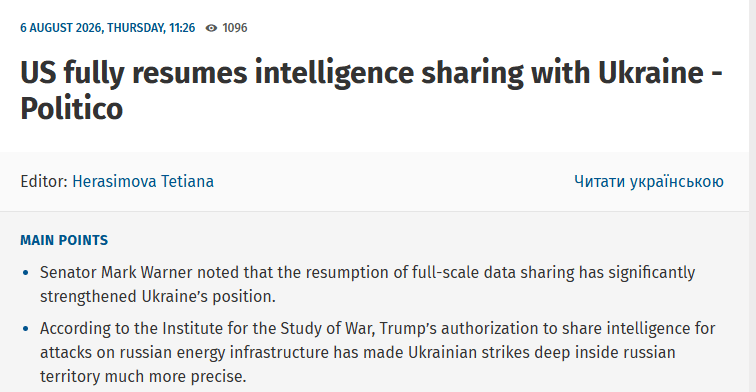
Both of these arguments are made for psychologically transparent reasons. These arguments are made because anti-Trump people don’t want to support Trumpian foreign policy, and his supposed ditching of Ukraine gives them a psychological pass to continue supporting Ukraine without cognitive dissonance. Trump’s abandonment of Ukraine is proof of a just war. It is the perfect motivated reasoning. But it’s just not true. Ukrainian drone and missile battery operators ask the US military where a target is, the US provides the coordinates, and Ukrainians press the button. This has been especially useful in the 40 days of “deep strikes” into Russia, as Mark Warner, the Virginia senator said just last week.
And the missiles being launched when those buttons are pressed are American, French, British and Ukrainian. While it’s true that American missiles (ATACMS, HIMARS, Javelin and others) are now being routed via Europe through a NATO slush fund to give Trump plausible deniability to satisfy a campaign promise, it’s a charade. Everyone knows what’s going on.
As for the idea that the US has no real stake or preferred outcome and is just a disinterested corporate concern that looks to cash-in wherever it can, that is mainly false. Of course the US military industrial complex does want to profit where it can, but it doesn’t sell weapons to everybody, obviously. It doesn’t sell weapons to Russia, Iran or North Korea, and if the people who make this argument followed the logic as to why, they might start to get somewhere. They don’t sell weapons to these countries because these are the enemies of empire. Which means, of course, that the empire has a stake in a country fighting against one of these enemies. But if you call it a proxy war in which western interests are being pursued through Ukraine, and for which an estimated two to three thousand Ukrainians are being killed or wounded weekly, people get upset and call you a Putin apologist. People get especially upset when you present the long evidentiary evidence of western influence and involvement in Ukrainian politics and its role as a proxy. The WikiLeaks cables were incredibly clear on this, leaked cables that Putin and the Russian leadership are also able to read, by the way.
In 2008, in a conversation with John McCain, Joe Lieberman and Lindsey Graham, Tony Blair said western strategy “should be to make Russia a little desperate with our activities in areas bordering on what Russia considers its sphere of interest and along its actual borders.” This meeting came just 10 days before the 2008 Budapest summit where the west affirmed that Ukraine and Georgia “will become” NATO members.
Is this not a clear intent to provocation? Does this not disprove the claim that Russia’s concerns are mere paranoia? Perhaps you’re thinking one cable isn’t enough.
Two years prior, in October 2006, US diplomats in Moscow reported back to Washington DC on Russian fears that the United States was using the colour revolutions to “encircle Russia with hostile regimes and NATO bases,” showing that the US was fully aware Moscow considered the expansion of western influence in former Soviet states as a strategic campaign against Russia.
In a 2011 cable to Washington DC by the Stratfor Consultancy, which acts as a revolving door for CIA, state department, and US military intelligence personnel to jump between the public and private sector, Ukraine was described as “the cornerstone to Russia’s defence and survival as any sort of power.” Diplomats understood very well the importance of Ukraine to Russia, confirmed in a 2013 cable in which Stratfor described Ukraine as “Russia's soft underbelly.” The assessment admitted that “for a western power, Ukraine is of value only if that power is planning to use it as a weapon against Russia.”
Remember, Putin will have read these cables too. What is he supposed to have concluded about the reasons for western influence in Ukraine?
Of course none of this background and vital context is ever referenced in any reporting about the war.
Another common argument which attempts to refute the proxy positioning (and one I do have a little more sympathy with) rests on Ukraine’s agency and sovereignty. Ukrainians wanted NATO and EU integration, and whether that works for or against the interests of Russia or the west, who is anyone to deny them that right? Firstly, this is largely not the case. Support for EU integration was often higher than support for NATO, but not always supported by a majority, and both were strongly divided by region, language, age and political identity. But even if support for both had been uniformly high, this still doesn’t mean pursuing those goals wasn’t a reckless policy that led to war. It doesn’t mean that the leadership was bound to follow majority public sentiment at a particular moment in time, especially when that sentiment would put them on a path to war. This is why we elect leaders. Leaders with access to information about the concerns and position of other states and leaders, about war and peace and the best way to avoid it.
And the evidence here is also clear: the west dismissed the draft texts of security arrangements presented by Russia over the years, the latest of which was in December 2021 when Russia sought to negotiate NATO expansion. But we’re not allowed to talk about this either, because discussing Russia’s numerous attempts to secure a new security arrangement with NATO undercuts the idea that the war is one of conquest and territorial ambition. We’re definitely not allowed to talk about the fact that early in his presidency Putin sincerely floated the idea of Russia joining NATO as a straightforward way to ensure peace in Europe.
Again, context elided in all mainstream war coverage.
Putting all of this evidence aside, some commentators claimed that my argument excused every military invasion in the past and all hypothetical ones in the future. So Hitler was provoked to invade Poland? Israel was provoked to invade Gaza? A US invasion of Greenland or Cuba would be ok because they could justify it by invoking national security?
Firstly, I went out of my way to make it clear I was analysing the conditions that led to the actions, rather than excusing the actions themselves. Because, as mentioned, my intention was not to make a normative moral argument, but to analyse why the war happened, how it could be stopped, and how to prevent such wars in the future.
Secondly, the easiest answer to all these past examples and hypothetical futures is…..no. None are analogous with Russia-Ukraine. Greenland and Cuba are not seeking to join a hostile military alliance against the US (when an analogous event did happen of course it brought the world to the brink of nuclear war). Nazi Germany’s desire for lebensraum was openly stated and within seven months they’d also invaded Denmark and Norway. As for Israel, well Israel is the provocation, a state created 78 years ago out of thin air and placed on top of historic Palestinian homelands. The Palestinians were the ones provoked. Every subsequent armed assault was resistance. But these examples are revealing of a very common tactic so often used to suppress rational analysis over Russia-Ukraine: the positing of a false equivalence to support a position which breaks down under examination.
Others said that NATO expansion and Ukrainian militarisation was nothing but a fig-leaf to hide an expansionist doctrine aimed at the total control of Ukraine, but this doesn’t answer why Russia waited until 2022 to invade, and also assumes every Russian statement about NATO expansion, every draft security arrangement was nothing more than an elaborate long game. This doesn’t feel like a serious argument.
The people who make this argument also like to argue that this is a war of totalitarianism versus democracy. Indeed, just yesterday Zelensky pointed to Russia’s attempt to ban a minor political party called Yabloko as evidence of this. Yet this is another fairy-tale, a crucial building block in the justification architecture which ignores the fact that after the 2022 invasion Zelensky banned eleven political parties, including the second-largest party in the Ukrainian parliament. This party, the Opposition Platform For Life, had 43 parliamentary seats and had condemned Russia’s invasion. Its sin was to advocate for negotiation rather than all-out-war with Russia.
Ukraine is a one-party state under martial law in which young men are regularly kidnapped off the streets and bundled into unmarked vans by regime henchmen to be fed into the meat grinder, all supported by the west. It is no wonder most Ukrainians no longer support continuing the fighting and favour a negotiated end.
Those who support this war until the last Ukrainian are the elites in Ukraine, Europe and the US whose husbands, fathers, sons and brothers are not being sent to die an ignominious death.
Those who indulge in double-standards, false equivalences and fairy-tale narratives do so to avoid the painful unravelling of their cognitive dissonance.
And those who make peace impossible make war inevitable.
Thanks to everyone who stayed with me for another round, I appreciate the support.
(My work is only possible thanks to the generosity of my readers. You can support me with a donation here or by upgrading your subscription).
Thanks for your excellent analysis. I can offer an explanation for the madness of people's lust for WWIII. Tony Judt, the historian, said (and this is key, very important, and also remember, this wasn't intended to be heard and understood by the masses): "In order for a democracy to wage war, it must first build a war psychosis in its population." What we are surrounded y is a psychosis. This is now a psychotic society. It is very very scary indeed. I don't watch, read or listen to MSM, so have been spared the psychosis.
Thank you, a worthy and worthwhile article :)
I know you use authorization codes to secure comment access, but is it possible that some measure of negative comments on the prior article were bots? They are rampant in much of online media, averaging fifty percent from what I've read.
As to Putin's apparent failure to recognize the obvious. I don't think he did, or does, I think he was always playing for time once the conflict began. How come?
Because, way back when the US called for a flight ban over Libya at the UN, and got it. Putin and probably others genuinely believed it was done with honorable intentions. There is a video of his face when, as he sat in the UN, he realized the US was bombing Libya into oblivion. His shock is of a visceral level, he realizes he is staring into the abyss.
I doubt anything since then has changed his mind, now he may hope for ethics to emerge within the US and EU, but he doesn't anticipate it any time soon. Medvedev's views are certainly Putin's as well.
From the moment "Cookies" Neuland showed up in Ukraine I knew they were an expendable attack dog. And anyone familiar with Z's rise to power is well aware he is a pawn and corrupt cash, drugs and possibly children bagman for US politicians. Do you seriously believe all of those congressional junkets are to have first hand insight into the war, nonsense; they are to take advantage of no search diplomatic flights.
Thank you again!