

This morning The Guardian had a story about Israel’s ongoing efforts to illegally annex the West Bank.
Can you pick your way through this headline?
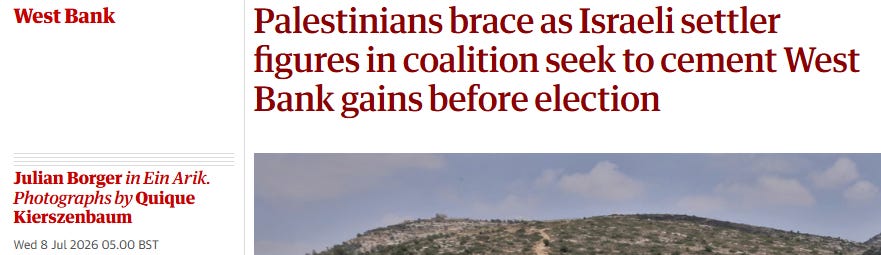
Firstly, the presentation of “settler figures” is a subtle way to shift responsibility away from the political arrangement in Israel and conjure up images of civilian crazies, even though numerous government ministers responsible for Israeli policy, including Ben Gvir and Smotrich, are settlers! (And of course the headline demands you accept the underlying premise that not all Israelis are settlers.)
The presentation is intended to create the impression of a few extremist bad apples within a legitimate government, a “coalition,” no less, a deliberate insertion intended to convey a messy political situation in which there is a divide between extremists and non-extremists. A divide which in reality doesn’t exist. In reality there is no distance between “settler figures” and the Israeli government. They are one and the same.
And how about “cement gains?” The “gains” the headline refers to are the illegal expansion of West Bank settlements, expansion which is happening because the entire Israeli government has created the legal framework to enable it, supported by the military. The “gains” are the de facto annexation of West Bank territory, an expansionist policy illegal under both international law and the 1948 UN partition agreement.
If the Guardian had any integrity and wasn’t simply a soft mouthpiece for empire dressed in progressive clothing, the headline would read “Israel advances illegal annexation of West Bank.” It certainly would if they were writing about Russia, which is another clue about the intention here. Can you imagine the Guardian soft-balling it like this over Ukraine?
“Russian government figures seek to cement Crimea gains.”
Of course not!
Why there is such a large difference in approach between how Israel’s actions are presented and how Russia’s actions are presented? Because Israel is a key outpost of colonial empire, essential to western hegemony, and Russia is the approved enemy.
Russia’s actions are automatically wrong and bad.
Israel’s actions have context and nuance.
The difference is also because most western journalists are Zionists. That is to say they believe Israel, unlike Russia, is a legitimate state and must continue to exist as it is (whether next to a Palestinian state or not). As such, they use language which carefully curates an image of Israel as a country influenced by bad actors, but not as an inherently bad, illegitimate state. Because illegitimate states have no right to exist and should be dismantled. But to demand the dismantlement of an illegitimate state would be antisemitism. And good liberals are not antisemites!
Many at The Guardian also no doubt believe in the fabled and dead “two-state solution,” without understanding that the call for two states, rather than a singular state, is the diplomatic and rhetorical trick which since 1948 has underpinned Israeli apartheid, mass murder, genocide and war crimes.
The Guardian is more insidious than Fox News, or the Daily Mail, because it uses more sophisticated language and nuance to do exactly the same job as the right-wing press. The Guardian scripts a story about the good guys and the bad guys, but cloaks it in a progressive sheen to hit the liberal pleasure centres of the brain to reinforce the exact same empire narratives as the right. The Guardian is more insidious than right-wing media because it gets decent people who instinctively are on the side of justice to buy into unjust worldviews which uphold empire.
This is, and was, extremely obvious in their coverage of Iran, which fever-pitched during the US-Israel attack.
The Guardian’s editorial line was essentially that the US shouldn’t have attacked Iran, but Iran is bad because of religious rule and protest crackdowns and internet blocks, so while you can disagree with Trump it’s also bad to support Iran because they are bad too. So where does that leave us? It leaves us, intentionally, drifting in a sea of ideological confusion. It leave us not understanding the rationale, logic and legally protected right to resistance against aggression. It leaves us not understanding other cultures, other systems of governance. It leaves us, deliberately, not understanding the fundamental contours of the imperialist world.
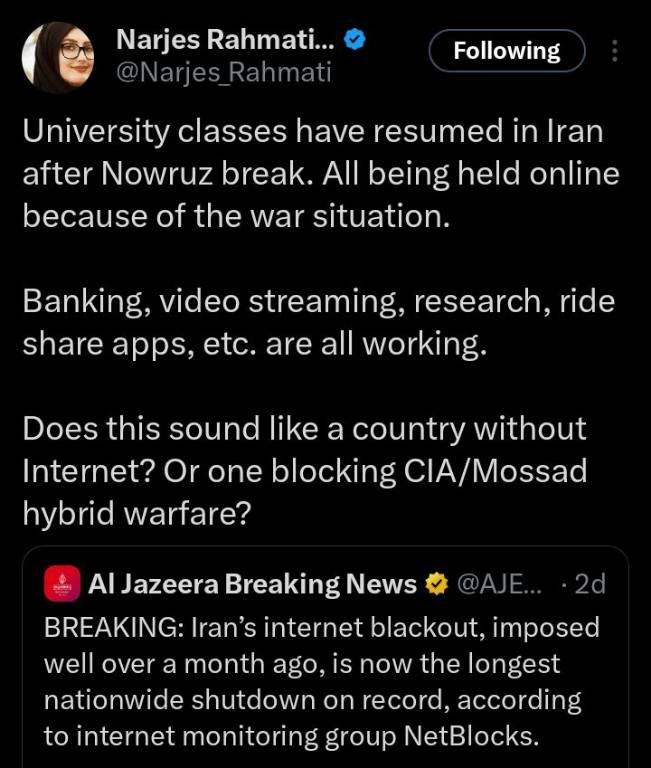
There was no effort in The Guardian’s coverage of Iran to explain that the government (which is always referred to using the selectively applied, delegitimising ‘regime’ descriptor) actually has huge popular support. There was no outrage at the assassination of Iranian leaders, no attempt to explain how egregious a breach of international law and norms the targeted mass killing of government officials was. There was deception regarding the internet “blackout”, with stories presenting it as an authoritarian move to prevent Iranians communicating with the outside world, when in reality all local websites remained accessible, and the block was enacted only against sites hosted in the west because they were in a war with two nuclear powers and feared cyberattack via sites known to collude with US authorities. In any case, basic VPNs also enabled access to international sites.
Rather than genuine attempts to inform readers about the situation in Iran, there was soft-peddling of imperial crimes, combined with constant attempts to undermine Iranian governance and resistance, all of which amounted to a barely-disguised justification for regime change efforts, with a few de rigueur anti-Trump articles focused on his language and threats.
In the weeks before the attack there were even efforts to soften progressives up with nonsense stories about Iran’s old oil tankers and the threat they posed to the environment. Regime change propaganda disguised as pro-environmentalism.
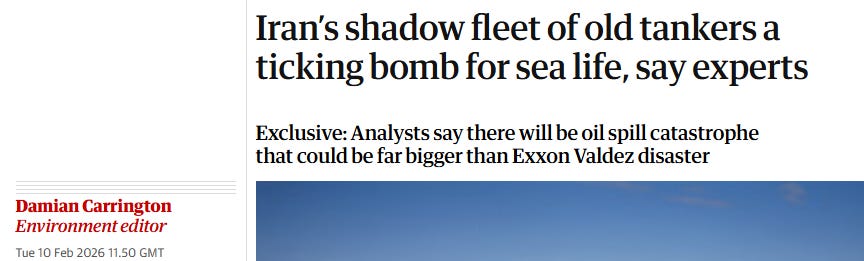
There were no stories subsequent to the attacks about the harm to the environment from the bombing of Iranian oil facilities which literally set Tehran’s streets on fire. (Also note the use of “shadow fleet”, a meaningless term which has become integral to buttress empire narratives. It implies illegality, but simply means that a country has been sanctioned by the US and continues to operate ships in “violation” of sanctions which have zero power under international law).
And two weeks before the US-Israeli attacks began, The Guardian wrote a story about the children of Iran’s leaders studying in the west, presenting it as a symbol of the leadership’s hypocrisy. The reality? More than 110,000 young Iranians are currently studying in the west!
The Guardian also lied incessantly about the number of dead Iranian protestors during the December riots, and not once told readers that US and Israeli officials had boasted about orchestrating the violence, a fact even Jewish media acknowledged and reported on.
The Guardian is an imperial rag masquerading as respectable opinion for progressives but feeding subtle propaganda designed to maintain western dominance and shepherd imperial violence.
Sometimes the mask fully slips, such as when Israel and the US bombed Iran in June 2025 and their “international security” correspondent, Jason Burke, a raging Zionist, wrote a story salivating about the prospects for regime change. I posted about it on Twitter at the time, the tweet went viral, and the headline was quickly changed. (You won’t find it now, but I took a screenshot).
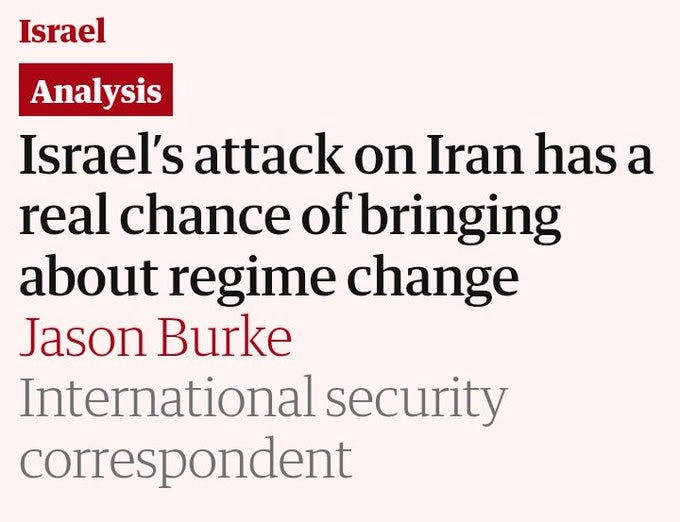
But this is the impulse that always lies beneath.
It is the impulse that refers to illegal annexation as “gains”, or illegal Israeli invasions as the “expansion of ground campaigns.”
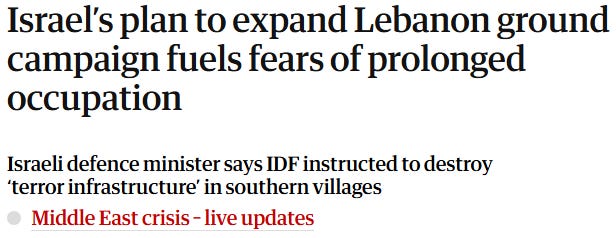
You’ll find the same impulses over their Cuba coverage, with constant references to “the Cuban regime,” the implication always that a liberal democracy is more legitimate than a revolutionary state or any other political formation, regardless of behaviours. A liberal democracy which does genocide and war crimes is intrinsically better than a revolutionary state which has universal healthcare and doesn’t mass murder civilians, so goes twisted empire-brained logic.
This Guardian story, while reporting critically on Trump’s threats to Cuba, says that even if the US did a Maduro-style kidnapping of leader Díaz-Canel, it would “leave in place the repressive communist regime.” The Guardian considers the only downside to another flagrant breach of international law is that it wouldn’t actually achieve regime change. Because they just can’t help themselves. You can be sure that when the US does finally invade, The Guardian will have a long, congratulatory piece on the end of the regime, replete with quotes from “Cuban” Americans living in Miami who’ve never set foot on the island.
Am I being too harsh? I don’t think so.
Of course, on occasion, The Guardian writes decent articles about war crimes, Israel and US imperialism, but this is part of the problem. You’ll read about horrific Israeli crimes one day, but these will never be placed in the context of an illegitimate apartheid state. They will always stop short of anything which smells of true justice, and too often will collude in selling the imperial story. They’ll tell us how bad Trump is, but present him as the outlier rather than the continuation of 250 years of American violence. They’ll softly condemn US violence while delegitimising the target of that violence. They’ll report on genocide, but stop reporting on genocide when the pace of the mass murder declines.
All that said, I won’t stop reading the Guardian, because identifying how liberal media sells imperial propaganda to a progressive audience is critical to dismantling empire narratives.
And if you read it, I’m not suggesting you stop either.
But read it with a critical eye, pick out the imperial tells, and never rely on it for your worldview.
(The financial support of my readers keeps this newsletter regular and free. If you’d like to support me, please consider buying me a coffee or upgrading your subscription).
IMO the worst offender is probably Jonathan Freedland, who managed to cover the last US election without mentioning the situation in Palestine once, but he's not alone. There are a handful of Guardian bylines one learns to skip on sight as unreadable.
one thing this piece highlights well is that bias isn't only about what's reported, it's also about the verbs, nouns, and adjectives that quietly shape how readers interpret events